Fiscal Policy- changes in the expenditures or tax revenues of the federal government.
2 tools of fiscal policy
1. Taxes- government can increase or decrease spending.
2. Spending- government can increase or decrease spending.
Deficits, Surplus, and Deficit
- balanced budget
+revenues= expenditures
(it has been 16 years since we have had one)
- budget deficit
+revenues < expenditure
-budget surplus
+revenues > expenditures
- government debt
+sum of all deficits - sum of all surpluses
-deficits
+government must borrow money when it runs a budget deficit
+government borrows from:
1. individuals
2. corporations
3. financial institutions
4. foreign entities of foreign government
Fiscal Policy Two Options
- discretionary fiscal policy (action)
+expansionary fiscal policy (think deficit)
+contraction fiscal policy (think surplus)
+Non- Discretionary fiscal policy (no actions)
Discretionary VS. Automatic Fiscal Policies
Discretionary-
+Increasing or decreasing governments spending and/ or taxes in order to return the economy to full employment discretionary policy involves policy makers doing fiscal policy in response to an economic problem.
CAN NOT HAPPEN AT THE SAME TIME
Automatic-
+unemployment compensation and marginal tax rates are examples of automatic polices that help militate the effects of recession and inflation. Automatic fiscal policy takes place without policy makers having to respond to current economic problems.
Expansionary Fiscal Policy (easy) VS. Contraction Fiscal Policy (tight)
* combat a recession *combat inflation
*increase government spending * decrease government spending
decreases taxes increase taxes
Automatic or Built in Stabilizers
-anything that increases the government's budget deficit during a recession and increases its budget surplus during inflation without requiring expect action by policy makers.
EX. transfer payments, social security, Medicare, medicate, unemployment, VA benefits
Tax Structures
- progressive tax system
+average tax rate rises with GDP
EQUATION: tax revenue
------------------
GDP
-proportional tax system
+average tax rate remains constant as GDP changes
-regressive tax system
+average tax rate falls with GDP
Monday, February 29, 2016

Thursday, February 25, 2016
Here is a link below that can explain further in depth about consumption and spending ! Hope you all enjoy it ! :)
https://www.youtube.com/watch?v=vj7XExwChwI
https://www.youtube.com/watch?v=vj7XExwChwI
Consumption and Savings
-disposable Income (DI)
-income after taxes or net income
- DI=gross income - taxes
2 choices
-with disposable income, households can either
+consume (spend money on goods and services)
+save (not spend money on goods and services
Consumption
-household spending
-the ability to consume is constrained by
+the amount of disposable income
+the propensity to save
-do households consume DI= 0
+autonomous consumption
+dis saving
Saving
-household NOT spending
-the ability to save is constrained by
+the amount of disposable income
+the propensity to consume
-do house holds save if DI= 0?
+NO
APC and APS
APC= Average Propensity to Consume
APS= Average Propensity to Save
ALWAYS =1
*APC + APS = 1
* 1 - APS= APC
*APC> 1 (dis saving)
* -APC (dis saving)
Marginal Propensity to consume (MPC)
-the fraction of any change in disposable income that is consumed
EQUATION: Change in Consumption
--------------------------------
Change in Disposable Income
MPC= ΔC
-------
ΔDI
Marginal Propensity to Save (MPS)
-the fraction of any change indisposable income that is saved
EQUATION: Change in Savings
-----------------------------
Change in disposable income
MPS= ΔS
-------
ΔDI
Marginal Propensity
ALWAYS = 1
* MPC + MPS= 1
*MPC = 1 - MPS
*MPS = 1 - MPC
***********remember, people do two things with their disposable income, they consume it or save it*******
The Spending Multiplier Effect
- an initial change in spending (C, Ig, G, Xn) causes a larger change in aggregate spending (AS) or aggregate demand (AD)
EQUATION: Change in AD
-----------------------
Change in spending
Multiplier= ΔAD
---------------
ΔC, Ig, G, or Xn
Calculating the Spending Multiplier
-the spending multiplier can be calculated from the MPC or MPS
Multiplier= 1 1
-------- OR -----
1 - MPC MPS
-multipliers are positive (+) when there is an increase in spending, a negative (-) is when there is a decrease.
Calculating the Tax Multiplier
-when the government taxes, the multiplier works in reverse
+because now money is leaving the circular flow
Tax Multiplier (it's negative)
= -MPC -MPC
------------ OR ----------
1- MPC MPS
-if there is a tax cut then the multiplier is positive, because there is now more money in the circular flow
-disposable Income (DI)
-income after taxes or net income
- DI=gross income - taxes
2 choices
-with disposable income, households can either
+consume (spend money on goods and services)
+save (not spend money on goods and services
Consumption
-household spending
-the ability to consume is constrained by
+the amount of disposable income
+the propensity to save
-do households consume DI= 0
+autonomous consumption
+dis saving
Saving
-household NOT spending
-the ability to save is constrained by
+the amount of disposable income
+the propensity to consume
-do house holds save if DI= 0?
+NO
APC and APS
APC= Average Propensity to Consume
APS= Average Propensity to Save
ALWAYS =1
*APC + APS = 1
* 1 - APS= APC
*APC> 1 (dis saving)
* -APC (dis saving)
Marginal Propensity to consume (MPC)
-the fraction of any change in disposable income that is consumed
EQUATION: Change in Consumption
--------------------------------
Change in Disposable Income
MPC= ΔC
-------
ΔDI
Marginal Propensity to Save (MPS)
-the fraction of any change indisposable income that is saved
EQUATION: Change in Savings
-----------------------------
Change in disposable income
MPS= ΔS
-------
ΔDI
Marginal Propensity
ALWAYS = 1
* MPC + MPS= 1
*MPC = 1 - MPS
*MPS = 1 - MPC
***********remember, people do two things with their disposable income, they consume it or save it*******
The Spending Multiplier Effect
- an initial change in spending (C, Ig, G, Xn) causes a larger change in aggregate spending (AS) or aggregate demand (AD)
EQUATION: Change in AD
-----------------------
Change in spending
Multiplier= ΔAD
---------------
ΔC, Ig, G, or Xn
Calculating the Spending Multiplier
-the spending multiplier can be calculated from the MPC or MPS
Multiplier= 1 1
-------- OR -----
1 - MPC MPS
-multipliers are positive (+) when there is an increase in spending, a negative (-) is when there is a decrease.
Calculating the Tax Multiplier
-when the government taxes, the multiplier works in reverse
+because now money is leaving the circular flow
Tax Multiplier (it's negative)
= -MPC -MPC
------------ OR ----------
1- MPC MPS
-if there is a tax cut then the multiplier is positive, because there is now more money in the circular flow
Wednesday, February 24, 2016
More about Classical VS. Keynesian
Classical Keynesian
- competition is good the invisible hand -competition is flawed
(economy will fix itself) -AD is the key not AS
-economy will balance at full employment -in saving cause recession leaves
-believed in the trical down effect -ratchet effects and sticky wages block
-economy is always close to or at Say's Law
full employment - in the long run we are all dead
- competition is good the invisible hand -competition is flawed
(economy will fix itself) -AD is the key not AS
-economy will balance at full employment -in saving cause recession leaves
-believed in the trical down effect -ratchet effects and sticky wages block
-economy is always close to or at Say's Law
full employment - in the long run we are all dead
Classical VS. Keynesian Debate
Topic Classical Keynesian
Modern followers - Adam Smith -J.M Keynes
-J.B Say
-David Ricardo
-Alfred Marshall
----------------------------------------------------------------------------------------------------------------------
Say's Law -supply creates its own demand -depression refuit Say's Law
-production= income= spending -demand creates its own supply
-under spending is unlikely -under spending persist
-whatever output that is production will be demanded
-----------------------------------------------------------------------------------------------------------------------
Savings and -Savings=Investment Income Saving does not equal investment
Investments Savings(leakage)=investment Different Motivations
(injection) Savings Motivations
-future needs -interest rates
-precaution -rate of profit
expectations
-habit
-income level
1965 -interest rate
-------------------------------------------------------------------------------------------------------------------------
Lonable Funds Market -investment from savings, cash,
checking accounts
Ig=gross investment -lending creates money which
r=real interest rate causes supply of money to
sm= supply of money increase (-->sm ^)
-inflation and unemployment
are unstable
------------------------------------------------------------------------------------------------------------------------
Wage/price flexibility -prices and wages are -prices and wages are inflexible
flexible downward downward(ratchet effect)
-----------------------------------------------------------------------------------------------------------------------
Supply Curve -vertical line -horizontal line
-----------------------------------------------------------------------------------------------------------------------
Output and Employment -AS determines output and -AD determines output and employment employment
--------------------------------------------------------------------------------------------------------------------------
Unemployment -rarely exists due to wage/ -usually exists with
price flexibility +external (war)
s=saving -cause:external (war) +internal
i=investment (s does not equal i)
-------------------------------------------------------------------------------------------------------------------------
Aggregate Demand (AD) -AD determines the price -AD changes due to the
level determinate
-AD reasonably stabled if -AD is unstable even if money
money supply is stabled supply is stabled due to fluctuation
in investment spending
-----------------------------------------------------------------------------------------------------------------------
Basic equation MV=PQ (1965-1972) C+Ig+g+Xn=GDP
(1973-present)
------------------------------------------------------------------------------------------------------------------------
Role of Government -monitory rules -believed in fiscal policy
-maintain a steady money supply (tax and spend)
-Laiz Fairs is best -believe in an active government
-economy is self regulating -economy is not self regulating
-------------------------------------------------------------------------------------------------------------------------
Inflation -caused by too much money -caused by too much demand
% Change in PL^
--------------------------------------------------------------------------------------------------------------------------
How long the short -short time -very long time
run is
-----------------------------------------------------------------------------------------------------------------------
Emphasis Today -microeconomics -macroeconomics
Modern followers - Adam Smith -J.M Keynes
-J.B Say
-David Ricardo
-Alfred Marshall
----------------------------------------------------------------------------------------------------------------------
Say's Law -supply creates its own demand -depression refuit Say's Law
-production= income= spending -demand creates its own supply
-under spending is unlikely -under spending persist
-whatever output that is production will be demanded
-----------------------------------------------------------------------------------------------------------------------
Savings and -Savings=Investment Income Saving does not equal investment
Investments Savings(leakage)=investment Different Motivations
(injection) Savings Motivations
-future needs -interest rates
-precaution -rate of profit
expectations
-habit
-income level
1965 -interest rate
-------------------------------------------------------------------------------------------------------------------------
Lonable Funds Market -investment from savings, cash,
checking accounts
Ig=gross investment -lending creates money which
r=real interest rate causes supply of money to
sm= supply of money increase (-->sm ^)
-inflation and unemployment
are unstable
------------------------------------------------------------------------------------------------------------------------
Wage/price flexibility -prices and wages are -prices and wages are inflexible
flexible downward downward(ratchet effect)
-----------------------------------------------------------------------------------------------------------------------
Supply Curve -vertical line -horizontal line
-----------------------------------------------------------------------------------------------------------------------
Output and Employment -AS determines output and -AD determines output and employment employment
--------------------------------------------------------------------------------------------------------------------------
Unemployment -rarely exists due to wage/ -usually exists with
price flexibility +external (war)
s=saving -cause:external (war) +internal
i=investment (s does not equal i)
-------------------------------------------------------------------------------------------------------------------------
Aggregate Demand (AD) -AD determines the price -AD changes due to the
level determinate
-AD reasonably stabled if -AD is unstable even if money
money supply is stabled supply is stabled due to fluctuation
in investment spending
-----------------------------------------------------------------------------------------------------------------------
Basic equation MV=PQ (1965-1972) C+Ig+g+Xn=GDP
(1973-present)
------------------------------------------------------------------------------------------------------------------------
Role of Government -monitory rules -believed in fiscal policy
-maintain a steady money supply (tax and spend)
-Laiz Fairs is best -believe in an active government
-economy is self regulating -economy is not self regulating
-------------------------------------------------------------------------------------------------------------------------
Inflation -caused by too much money -caused by too much demand
% Change in PL^
--------------------------------------------------------------------------------------------------------------------------
How long the short -short time -very long time
run is
-----------------------------------------------------------------------------------------------------------------------
Emphasis Today -microeconomics -macroeconomics
Monday, February 22, 2016
Interest Rates and Investment Demand
What is investment?
-money spent or expenditures on:
+New Plants factories)
+ Capital equipment (machinery)
+Technology hardware and software)
+New homes
+inventories goods sold by procedures)
Expected Rates of Return
How does business make investment decisions?
- cost/benefit analysis
How does business determine the benefits?
-expected rate of return
How does business count the cost?
-interest costs
How does business determine the amount of investment they undertake?
-compare expected rate of return to interest cost
+if expected >interest cost, then invest
+if expected return < interest costs, then do not invest
Real Interest Rate (r%) Vs. Nominal Interest Rate (i%)
Whats the difference?
- nominal is the observable rate of interest. real subtracts out inflation (π%) an is only known as post factor.
r%= real interest rates
i%= nominal interest rates
π%= inflation rates
EQUATION: r% = i% - π%
What determines the cost of an investment decision?
- the real interest rate (r%)
Investment Demand Curve (ID)
What is the shape of investment demand curve?
-downward sloping
Why?
- when interest rates are high fewer investments are profitable; when interest rates are low, more investments are profitable.
Shifts in Investment Demand (ID)
-cost of production
+lower costs shift ID ---->
+higher costs shift ID <----
-business taxes
+lower business taxes shift ID ---->
+higher business taxes shift ID <---
- technological change
+new technology shifts ID --->
+lack of technological change shifts ID <---
-stock of capital
+if economy is low on capital, ID --->
+if economy has much capital, ID <---
-expectations
+positive expectations shift ID --->
+negative expectations shift ID <---
-money spent or expenditures on:
+New Plants factories)
+ Capital equipment (machinery)
+Technology hardware and software)
+New homes
+inventories goods sold by procedures)
Expected Rates of Return
How does business make investment decisions?
- cost/benefit analysis
How does business determine the benefits?
-expected rate of return
How does business count the cost?
-interest costs
How does business determine the amount of investment they undertake?
-compare expected rate of return to interest cost
+if expected >interest cost, then invest
+if expected return < interest costs, then do not invest
Real Interest Rate (r%) Vs. Nominal Interest Rate (i%)
Whats the difference?
- nominal is the observable rate of interest. real subtracts out inflation (π%) an is only known as post factor.
r%= real interest rates
i%= nominal interest rates
π%= inflation rates
EQUATION: r% = i% - π%
What determines the cost of an investment decision?
- the real interest rate (r%)
Investment Demand Curve (ID)
What is the shape of investment demand curve?
-downward sloping
Why?
- when interest rates are high fewer investments are profitable; when interest rates are low, more investments are profitable.
Shifts in Investment Demand (ID)
-cost of production
+lower costs shift ID ---->
+higher costs shift ID <----
-business taxes
+lower business taxes shift ID ---->
+higher business taxes shift ID <---
- technological change
+new technology shifts ID --->
+lack of technological change shifts ID <---
-stock of capital
+if economy is low on capital, ID --->
+if economy has much capital, ID <---
-expectations
+positive expectations shift ID --->
+negative expectations shift ID <---
Nominal Wage- amount of money received by a worker per unit of time (by hour, clocking in)Real Wages- amount of goods and services a worker can purchase with their nominal wage (purchasing power of your nominal wage)
Sticky Wages- the nominal wage level that is set according to an initial price level and does not very due to labor contracts and other restrictions.
Thursday, February 18, 2016
Aggregate Supply
Aggregate Supply- the level of Real GDP (GDPR) that firms will produce at each price level (PL)
+long run and short run
Long Run
-period of time where input prices are completely flexible and adjust to changes in the price level
-level of Real GDP supplied is independent of the price level
Short Run
-period of time where input prices are sticky and do not adjust to changes in the price level
-level of Real GDP supplied directly related to the price level
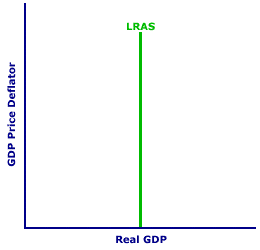
Long Run Aggregate Supply (LRAS):
- LRAS marks the level of full employment in the economy (analogous to PPC)
-Because input prices are completely flexible in the long- run, changes in price level do not change firms' real profits and therefore, does not change firms' level of out put. which means that the LRAS is vertical at the economy's level of full employment.
Short Run Aggregate Supply (SRAS)
-An increase in SRAS is seen as a shift to the right (SRAS ---->)

- A decrease in SRAS shifts to the left (SRAS <------)
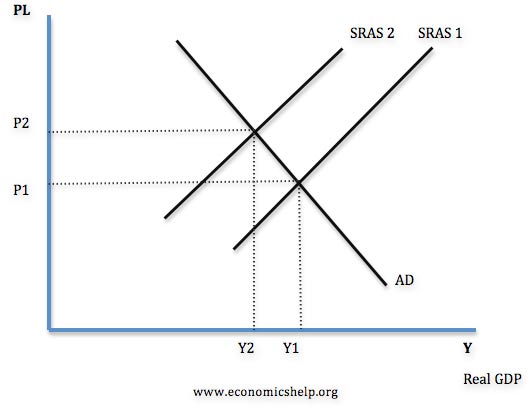
- Key to understanding shifts in SRAS is per unit cost of production.
EQUATION:
per unit production cost = total input cost
--------------------
total output cost
Determinate of SRAS :
(ALL AFFECTS UNIT PRODUCTION COST)
1. Input prices
2. Productivity
3. Legal - institutional enviroment
Input Prices
-domestic resource prices
+wages 75% of all business costs)
+ cost of capital
+ raw materials (community prices)
Foreign resource Price
Market Power
Increases in resources price= SRAS <---------
Decrease in resource price= SRAS --------->
Productivity
EQUATION: productivity= total output
----------------
total input
More productivity= lower unit production cost= SRAS ---->
Lower productivity= higher unit production cost= SRAS <----
Legal Institutional Environment
-Taxes and subsides
+ taxes ($ to government) on business increase per unit production cost = SRAS <---
+subsides ($ from government) to business reduce per unit production cost= SRAS ---->
- Government Regulation
+ creates a cost of compliance= SRAS <---
+deregulation reduces compliance costs= SRAS --->
+long run and short run
Long Run
-period of time where input prices are completely flexible and adjust to changes in the price level
-level of Real GDP supplied is independent of the price level
Short Run
-period of time where input prices are sticky and do not adjust to changes in the price level
-level of Real GDP supplied directly related to the price level
Long Run Aggregate Supply (LRAS):
- LRAS marks the level of full employment in the economy (analogous to PPC)
-Because input prices are completely flexible in the long- run, changes in price level do not change firms' real profits and therefore, does not change firms' level of out put. which means that the LRAS is vertical at the economy's level of full employment.
Short Run Aggregate Supply (SRAS)
-An increase in SRAS is seen as a shift to the right (SRAS ---->)
- A decrease in SRAS shifts to the left (SRAS <------)
- Key to understanding shifts in SRAS is per unit cost of production.
EQUATION:
per unit production cost = total input cost
--------------------
total output cost
Determinate of SRAS :
(ALL AFFECTS UNIT PRODUCTION COST)
1. Input prices
2. Productivity
3. Legal - institutional enviroment
Input Prices
-domestic resource prices
+wages 75% of all business costs)
+ cost of capital
+ raw materials (community prices)
Foreign resource Price
Market Power
Increases in resources price= SRAS <---------
Decrease in resource price= SRAS --------->
Productivity
EQUATION: productivity= total output
----------------
total input
More productivity= lower unit production cost= SRAS ---->
Lower productivity= higher unit production cost= SRAS <----
Legal Institutional Environment
-Taxes and subsides
+ taxes ($ to government) on business increase per unit production cost = SRAS <---
+subsides ($ from government) to business reduce per unit production cost= SRAS ---->
- Government Regulation
+ creates a cost of compliance= SRAS <---
+deregulation reduces compliance costs= SRAS --->
Monday, February 8, 2016
Friday 2/5/16 Notes
GDP Gap: the amount by which actual GDP falls short of potential GDP.
Okun's Law: for every 1% that the actual unemployment rat6e in which the actual unemployment excludes the actual rate at unemployment. A GDP gap of about 2%.
***************IMPORTANT EXAMPLE- In 2012 the unemployment rate for Mexico was 7.4% and the NRU was 6%******************
Rule of 70: It is used to determine how many years it will take for a value to double given a particular annual growth rate.
If you put $20,000 in the bank and it earns year interest of 7% how many years will it take your income to double.
70 divided
-------------
interest rate
In the problem above you would do 70/ 7 which will give you 10%
************ALWAYS DIVIDE BY 70****************
Okun's Law: for every 1% that the actual unemployment rat6e in which the actual unemployment excludes the actual rate at unemployment. A GDP gap of about 2%.
***************IMPORTANT EXAMPLE- In 2012 the unemployment rate for Mexico was 7.4% and the NRU was 6%******************
Rule of 70: It is used to determine how many years it will take for a value to double given a particular annual growth rate.
If you put $20,000 in the bank and it earns year interest of 7% how many years will it take your income to double.
70 divided
-------------
interest rate
In the problem above you would do 70/ 7 which will give you 10%
************ALWAYS DIVIDE BY 70****************
Thursday, February 4, 2016
Unemployment- failure to use available resources particularly labor to produce desired goods and services.
*Example: people now working
Underemployment- Examples: * When a school has so much talent but we don't use it
* Working less than 12 hours a week
Labor Force- above 16 years of age and those who are able and willing to work
(employ + unemployed)
-equation above makes up the labor force
Not in labor force- Military (majority time in other countries), students, retired people, disabled. home makers (stay at home mother/ father), mental home institutes, jail/prison, those who are not looking for a job
Unemployment rate- 4-5%= full employment or Natural Rate of Unemployment (NRU)
* having a percentage under 4% is great
# of unemployed
--------------------------------------------- x 100
# of employed + # of unemployed
*Example: people now working
Underemployment- Examples: * When a school has so much talent but we don't use it
* Working less than 12 hours a week
Labor Force- above 16 years of age and those who are able and willing to work
(employ + unemployed)
-equation above makes up the labor force
Not in labor force- Military (majority time in other countries), students, retired people, disabled. home makers (stay at home mother/ father), mental home institutes, jail/prison, those who are not looking for a job
Unemployment rate- 4-5%= full employment or Natural Rate of Unemployment (NRU)
* having a percentage under 4% is great
How to calculate the unemployment rate:
# of unemployed
--------------------------------------------- x 100
# of employed + # of unemployed
Types of unemployment
Frictional: those who are searching for a job, they are temporally unemployed or in between jobs, transferable skills but not working.
*Examples- college and high school graduates, people that were laid off
Structural: change in structure of the labor force made some skills obsolete, these people have no transferable skills and their jobs may never come back. Must learn new skills to get a new job.
*Example- NASA employee getting laid off
Seasonal: due to the time of year and the nature of the job
*Examples-school bus drivers, life guards, Santa Clause and Easter bunny impersonator, construction workers
Cyclical: unemployment that results in economic down turn such as recession as demand falls for goods and services, demand for labor falls and workers are laid off.
-full employment means there is no cyclical unemployment
Equation: Frictional + Structural= Natural Rate of Unemployment (NRU)
Tuesday, February 2, 2016
GDP Deflation- price index used to adjust from nominal to real GDP
equation: Nominal GDP
------------------- x 100 = GDP Deflation
Real GDP
- BASE = Nominal and Real GDP
- in the base year the GDP defoliator equals to 100
- years after base year GDP defoliator is greater than 100
- years before the base year GDP defoliator is less than 100
Consumer Price Index ( CPI ) - most commonly used measurement of inflation
- measures the market basket of goods for a typical urban American family
equation: Price of a market basket of goods in the current year price
------------------------------------------------------------------------ x 100
Price of the market basket of goods in the base year price
Inflation:
equation: Price index in year 2 - price index in year 1
-------------------------------------------------------- x 100
Price index in year 1
REAL INTEREST RATES
- percentage increase in purchasing power that the borrower must pay the lender for a loan.
equation: Nominal interest rate - inflation
(answer is usually under 10)
-unanticipated inflation (not expected)
- adjusted for inflation
VS
NOMINAL INTEREST RATES
- percentage increase in money the borrower must pay the lender for a loan
equation: Nominal interest rate = expected interest rate + inflation premium
- Anticipated inflation
* fisher effect
- not adjusted for inflation
UNANTICIPATED INFLATION
Hurt by inflation
1. Savers
2. Creditors/ lender ( people you owe)
3. People who are on a fixed income (welfare, elderly, retire, medicare, medicate)
Hurt by inflation
1. People who owe debt
Cola adjustment (elderly)
-automatic wage increase when inflation occurs
*New York
*California
-cost of living adjustment
equation: Nominal GDP
------------------- x 100 = GDP Deflation
Real GDP
- BASE = Nominal and Real GDP
- in the base year the GDP defoliator equals to 100
- years after base year GDP defoliator is greater than 100
- years before the base year GDP defoliator is less than 100
Consumer Price Index ( CPI ) - most commonly used measurement of inflation
- measures the market basket of goods for a typical urban American family
equation: Price of a market basket of goods in the current year price
------------------------------------------------------------------------ x 100
Price of the market basket of goods in the base year price
Inflation:
equation: Price index in year 2 - price index in year 1
-------------------------------------------------------- x 100
Price index in year 1
REAL INTEREST RATES
- percentage increase in purchasing power that the borrower must pay the lender for a loan.
equation: Nominal interest rate - inflation
(answer is usually under 10)
-unanticipated inflation (not expected)
- adjusted for inflation
VS
NOMINAL INTEREST RATES
- percentage increase in money the borrower must pay the lender for a loan
equation: Nominal interest rate = expected interest rate + inflation premium
- Anticipated inflation
* fisher effect
- not adjusted for inflation
UNANTICIPATED INFLATION
Hurt by inflation
1. Savers
2. Creditors/ lender ( people you owe)
3. People who are on a fixed income (welfare, elderly, retire, medicare, medicate)
Hurt by inflation
1. People who owe debt
Cola adjustment (elderly)
-automatic wage increase when inflation occurs
*New York
*California
-cost of living adjustment
Monday, February 1, 2016
Equations:
Budget Equation:
Government purchases of goods and services + government transfer payments - government tax and free collection
Trade:
Export - Imports
National Income:
2 equations:
1) Compensation of employees + rental income + interest income + corporate profits + proprietors income
2) GDP - indirect business taxes - depreciation - net foreign factor payment
Disposable Personal Income ( DPI):
national income - personal household taxes + government transfer payments
National Domestic Product (NDP):
GDP- depreciation
Nat National Product (NNP):
GNP - depreciation
Gross National Product:
GNP= GDP + net foreign factor payment
Budget:
+ = deficit
- = surplus
Trade:
+ = surplus
**DEPRECATION = CONSUMPTION OF FIXED CAPITAL**
---------------------------------------------------------------------------------------------------------------------
Normal GDP: is the value of out put produced in current year prices ( quantity)
- can increase from year to year if either out put or prices increases
Real GDP: is the value of out put produced in constant or based year prices ( adjusted for inflation)
- can increase from year to year only if quantity increases
******************** Economic growth use real GDP*********************
********Measure price increases (inflation) use Nominal GDP*********
Check out this link below for some great reference on how to calculate and different types of scenarios.
http://www.econport.org/content/handbook/NatIncAccount/CalculatingGDP/Examples.html
Budget Equation:
Government purchases of goods and services + government transfer payments - government tax and free collection
Trade:
Export - Imports
National Income:
2 equations:
1) Compensation of employees + rental income + interest income + corporate profits + proprietors income
2) GDP - indirect business taxes - depreciation - net foreign factor payment
Disposable Personal Income ( DPI):
national income - personal household taxes + government transfer payments
National Domestic Product (NDP):
GDP- depreciation
Nat National Product (NNP):
GNP - depreciation
Gross National Product:
GNP= GDP + net foreign factor payment
Budget:
+ = deficit
- = surplus
Trade:
+ = surplus
**DEPRECATION = CONSUMPTION OF FIXED CAPITAL**
---------------------------------------------------------------------------------------------------------------------
Normal GDP: is the value of out put produced in current year prices ( quantity)
- can increase from year to year if either out put or prices increases
Real GDP: is the value of out put produced in constant or based year prices ( adjusted for inflation)
- can increase from year to year only if quantity increases
******************** Economic growth use real GDP*********************
********Measure price increases (inflation) use Nominal GDP*********
Check out this link below for some great reference on how to calculate and different types of scenarios.
http://www.econport.org/content/handbook/NatIncAccount/CalculatingGDP/Examples.html
Subscribe to:
Posts (Atom)